Nomadness

Tales of the new direction at Nomadic Research Labs... the move to a ship named Nomadness

My Photo
Name: Steve Roberts
Location: Camano Island, Washington, United States

Saturday, August 30, 2008

Layers of Information

Update: I have just added a live tracker to the ship in addition to the datalogger that has been recording detailed routes. You can now see our current location, updated every 90 seconds while underway. Sometimes the transmitted position reports don't make it due to heavy traffic on the APRS channel, or we may be out of range of a shore station, but during the initial tests today (Sep 3) it worked beautifully. More tech details on this later - just wanted to add the link.
Anyway...

We've completed the minor loop to Anacortes, driven by the meeting with the thruster folk, but the journey was richer in texture than might be expected for such a specific technical quest. Enroute north, we stopped for a day in Cornet Bay... the ideal place to pause and take a breath before plunging through Deception Pass. That's one of the rites of passage for a Northwest sailor, and though it's reasonably uneventful at slack, it does take careful planning. Flood and ebb through the narrow rocky passage can run 8 knots of swirling whitewater, and YouTube is rife with videos of boats doing, shall we say, not so well.

This can be exacerbated by gale-force winds from the Strait of Juan de Fuca (which have been happening a fair bit lately), so we just paused a day, went for a long hike in the woods of Hoypus point, luxuriated in a 50-cent state-park shower, rowed over to meet Tim Flanagan of Navagear aboard Two Lucky Fish, kept an eye on NOAA and Mr. Tides, then calmly went for it. Other than getting buffeted sideways a bit, it was smooth... and we emerged into relatively open water and continued through Burrows Bay and around Shannon Point toward Anacortes with only one ferry-dance to quicken the heartbeat (I ended up doing a loop to escape the developing collision course, though another sailor stupidly insisted on holding his own and got a nasty blast of the horn as the behemoth implacably turned across his bow and forced an untidy evasive maneuver well inside the legal proximity limit.)

After a brief provocative glimpse of the BMW/Oracle 90-foot trimaran (I couldn't catch her), we landed at Cap Sante Marine, which kindly let us use their dock for a couple of nights while another storm system passed. Unfortunately, one of our fenders got gobbled by a big diamond-plate-covered gap overnight, whereupon the 25-30 knot wind ground us steadily on a wooden beam as we snoozed happily. The good news is that my hull is steel, and although an ugly bare spot was already rusting by morning coffee, we didn't have to contemplate the emergency structural patch that would likely have been required with a fiberglass boat. But still. This really sucks, and it is going to be expensive to bring the Awlgrip back to a smooth uniform gloss:


The irony of this happening at a boatyard was not lost on us. Alas, there's no blame but our own... there should have been more fenders out to protect us from the ragged dock with large gaposis, and when the wind came up we should have popped out of the hatch to check on things.

The thruster meeting went well, however, and we'll probably return in October to get an 8" hole drilled through the boat below waterline. That thought should make any sailor cringe, and coupled with the trauma of haulout I'll probably approach it the way my stockbroker handles the current investment climate: "gin and xanax." Once done, I will have 213 pounds of lateral thrust at the bow, just a touch of the joystick away. That should make close-in maneuvering less traumatic.


Friends Afloat

The escape from Anacortes was on a day of howling wind and intermittent rain, continuing this Pacific Northwest summer-from-hell that has seen only a few short sunny stretches. We were joined by two of my dearest friends, and motored down through Swinomish Channel (past the marina that held us captive last winter) and out into open water for a bit of sailing before tying up to wait out the Labor Day frenzy that renders all nearby anchorages and marinas zoo-like. Time on water with people I love... now this makes all the hard work worthwhile:


This might be a good time to mention something that really needs a proper web page of its own, and soon. The community aspect of sailing is one of the most alluring parts of all this, and we are seriously working to rekindle the "technomadic flotilla" idea that has been threading through my projects since the early '90s and almost materialized in the Microship era. We are envisioning a mobile tribe of boats bearing kindred spirits, practitioners of skills various, geeks of many stripes, and a core that remains constant and hostel-like, even through a slow turnover of participants.

Sky and I are both coming at this from different but overlapping perspectives. She sees it as a wandering group of actors, writers, artists, and musicians (which we have dubbed Dramanauts, hence her blog by that name). I see it more as a self-sufficient technomadic community that has reached a critical mass of skills and tools, and is thus able to respond to changing world situations (or pure whim) by relocating on a global scale. The two notions are quite compatible, and reflect our own passions.

If you're interested, let me know. We'll be writing much more about this soon.


Reverse Engineering and Ship Documentation

Meanwhile, I sit here on the boat as it rocks and creaks in the relentless late-August winds (?), piecing together a data structure that addresses a huge problem: getting a handle on the complexity of this system. The boat came with a few old drawings that were made before numerous changes, and even those are incomplete. One of the first projects, before even getting too deep into my own, is to figure out what is here... and yet, if I take that to fruition, I won't have time to add the essential systems and upgrades that are waiting in the wings.


It's a mess, in other words, and attempts to make new drawings have been mostly frustrated by variations in granularity or encapsulation that render it hard to know where to begin... or when to stop.

I finally hit on a solution, which I am implementing now in Filemaker 9 relational database software. Every object on the boat (something that one would actually think of as a physical entity, not internal parts or vague systems) has a corresponding database record... and this contains all relevant documentation including PDF and web files, serial number, power, location, commentary, spares, and so on. Basically, it's an inventory, with each item having an auto-assigned numeric ID.

A second table has one record per connection, and that can take any form from a cable to a piece of plumbing. The record identifies the involved objects, and also carries descriptive text along with a "short name" that matches the output of my labelmaker. Each connection also has a unique ID.

Portals inside each of these layouts reveal the magic. An object like a GPS would reveal perhaps three lines in a table, one for each connection that enumerates it: power, NMEA 0183 for serial data, and a drop from the NMEA 2000 backbone that links it to the main nav systems. At the same time, I could pop over to the record for that serial cable and see two lines in its portal: the GPS and the 0183-to-USB dongle that interfaces it to my Mac.

The elegance of this is the separation between objects and connections, allowing things other than one-to-one relationships. Other files in the same system provide reference to the DC distribution system (what's on this "INSTR" breaker?), the crossbar and configuration management tools owned by a dedicated microcontroller, maintenance history, and so on.

Doing it this way is incremental and thus non-intimidating, it's easy to edit, and it associates all the relevant information with each device... rather than my current protocol, if you can call it that, consisting of a huge filesystem of randomly named PDFs, web locations, text files, paper manuals, sketches somewhere in the notebooks, and my increasingly flawed and Google-dependent memory.

This is coming together well enough that I'll probably publish the technique when it's done enough to test properly... and in the meantime it's helping me get a handle on just what I have here.


Fair winds,
Steve

Thursday, August 21, 2008

Der Furler and Rainbooms

I write now from a place that I perceive as an outsider after only a month on the water, reminded of this quote from Gilbert Keith Chesterton:
The whole object of travel is not to set foot on foreign land; it is at last to set foot on one's own country as a foreign land.
It feels like that, swinging on a buoy off the shore of Camano Island — with the eye of an explorer, I take note of the boats, smelt fisherfolk, houses lining the shore, the August moon on the water. It even felt vaguely foreign when we returned "home," with the facilities deeply familiar yet somehow colorful in their novelty. I marveled at my piano, got to know my cat, strolled slowly between house and lab to take in the century-old firs and the chorus of birdsound.

I am pleased to discover that it didn't take long to see it with a fresh simplicity... like the old family home in Kentucky it is something to be closed down, the stuff not as connected to me as it once was, the myriad decisions about things much simpler. If something ain't boatable, part of the mobile lab, or needed for the base office, it needs to go away. Can't wait to get back to eBaying and FreeCycling... but first I have some more sailing to do.

The wake of Nomadness is now 289 miles long (as with all images on this blog, you can click for a larger version):


We kind of wimped out on the last day, from Port Townsend back to Camano Island - there was a small-craft advisory of 30 knots in the east end of the Strait of Juan de Fuca, and timing for the transit of Deception Pass precisely at slack was critical in this full-moon epoch of extreme tides. So we just drove around Whidbey Island, ending the day muscling into the wind for a few hours before at last rounding Rocky Point and easing up to a friend's mooring buoy.

We're taking a few days to visit and sail locally with friends before heading out again, conveniently lying low while yet another spell of bad weather passed in what must be the most dubious "summer" ever in the Pacific Northwest. Icky weather made for some purty moments, though...


Rigging Interlude

One of the best parts about wandering around, of course, is dropping in on friends... and high on the list of anticipated visits was Brion Toss, yacht rigger extraordinaire. His classic Rigger's Apprentice is the first book I reference when trying to get boat stuff to stick together, and his DVDs on rig tuning and inspection are legendary. We've crossed paths and corresponded over the years (he was even one of our sponsors on the Microship project), so I was most delighted to be able to meet for dinner at the famed Ajax Cafe in Port Hadlock and then welcome him aboard the next day in Port Townsend.

As soon as Brion stepped aboard Nomadness, his keen eye took in every detail of the rig... and I was relieved to hear mostly positive comments (he is very quick to spot flaws). Barely missing a conversational beat, he tweaked my mid-boom sheeting for improved power and lower friction:


I've had a few glitches with that mainsail furler in the photo and we discussed that; fortunately, he seemed unconcerned and made a few suggestions to streamline operation. But then, at the bow, he paused. "Hmm.... I think there's a safety issue here..."

The link plate on the jib furler, which connects this very highly stressed component to the bow of the boat, had no toggle and was just a split piece of stainless... and it was looking very tired. And, more weirdly, the bottom turnbuckle screw was so far out of the body that the little mark meaning "do not back out past this point!" was floating more than a half inch in space. We had no way of knowing how much thread was still in there holding the rig up, but it definitely was not enough.

Brion just happened to have a new link plate in the shop that had been acquired for another job and, although tied up for the rest of the day, knew a competent rigger with some time on his hands... so before long we were dropping the jib, loosening backstays, triangulating the mast with a couple of halyards tensioned to bow cleats, and disconnecting the headstay for the upgrade. Here's Brian Morningstar:


Looking back, this brief ordeal was almost relaxing compared with, say, the plumbing experience. More importantly, it removed another layer of obfuscation from the boat, giving me an insight into some of the forces involved and the complex interactions involved with the standing rig.

What Next?

A cusp nears, with our house sitter jetting back to Arkansas and no new one on the horizon (help!). I'm looking at some major projects (considerably updated and re-ordered by a month on the water), and winter moorage is starting in mid-October. What all this means for the next few weeks is not exactly clear, but we're itching to meander through the San Juans and Gulf Islands, then make our way to one of the Holy Grails of northwest sailing: Princess Louisa Inlet.

I'm also starting to lay the groundwork for some of the systems, and want to be sure I avoid a repeat of the La Conner syndrome from last year: oscillating slowly between house and boat, driven by lists of old things forgotten the previous time and new things stopping me in my tracks on one front after another. Dang, I need a measurement, a tool, a part... an hour and a half worth of diesel each way, the weeks flying by with too little progress.

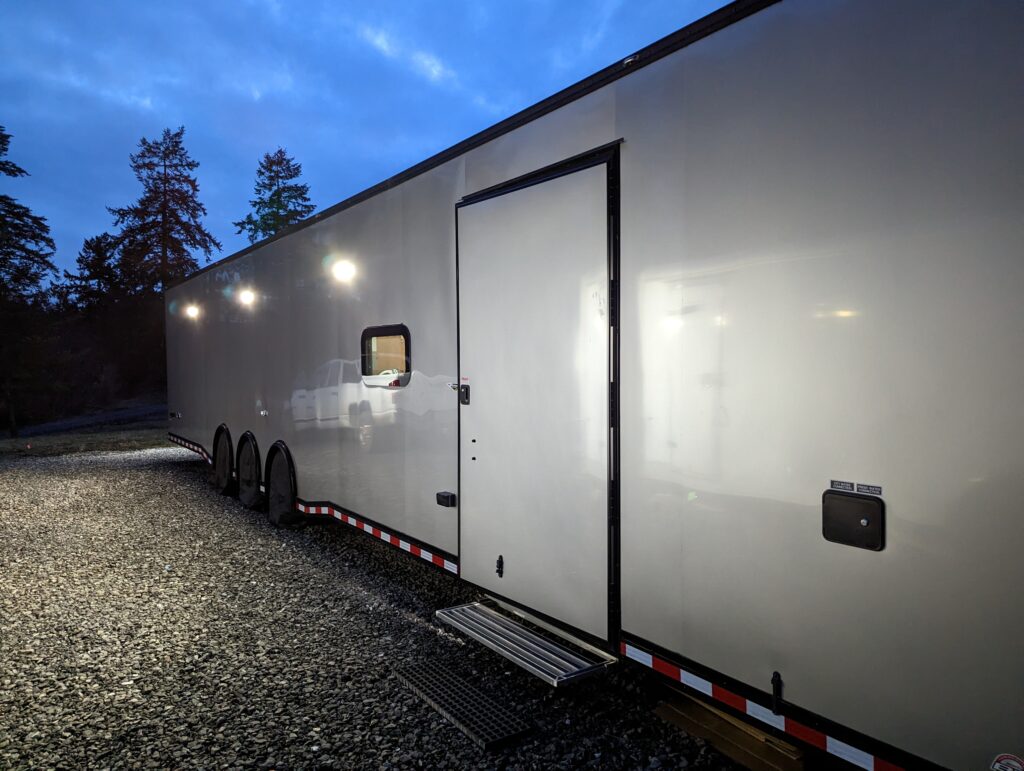
Since there are no marine facilities on Camano Island and I certainly can't afford to move to a waterfront place with my own dock, the solution to this problem will involve the mobile lab (my business is "Nomadic Research Labs," after all, so it's not that much of a stretch). The essence of my sloppy 3,000 square-foot building will be shoehorned into the 24-foot trailer that I used to haul the remnants of the old homestead from Kentucky, then parked somewhere near the boat's winter moorage. I don't want to lose momentum every time I need to rip a piece of okoume or sniff out some pesky RFI, and while enucleating the lab will gobble some overhead, it will also disambiguate the remainder.

In the meantime, 'tis the season for sailblogging, sun-addled brainstorming, and aimless meandering. Hard-core geekery and associated publications will come soon enough; I'm itching to hack N2K, deal with helm instrumentation, fire up the Rails server, build the comm console and hear those first SSB squawks, install the new power system, see solar panels sparkle in winter sun, sip from a watermaker, slurp data from every corner of the boat, stuff an iPod into a Fusion, watch video from bow and masthead, spew posits on 144.39, dink about with the field radio system, and start the publication series.

But first, a Dark 'n Stormy (Gosling's black rum and Reed's ginger beer) to go with this fresh Dungeness Crab...

Cheers from somewhere... Out There!
Steve

Friday, August 15, 2008

A Complex Sort of Languor

Although we have only been on the water for a month, the skewed perception of time that I first observed in my bicycling epoch has returned... and with it, a sort of virtual life extension. In retrospect, this journey feels like some indeterminate time on the order of 3 months, yet the present is so full that it appears to flit by with the days barely able to contain all the activity.

There are plenty of changes, and those form waypoints in the memory.

In contrast, staying in the same place all the time — even a nice place — yields the opposite temporal perception: real time seems to drag, but the past seems to have flown by. ("Has it really been 6 years since we saw each other??? Yikes!") This phenomenon is very hard to overcome, since the setting is constant and it all blurs together into a single undifferentiated jumble of memory, un-indexed by moments of discovery and the epochs of travel.

So that's my secret for living longer: keep moving. The number of years may be identical, but it will feel like more...

Fixing Your Boat in Exotic Ports

That's how some wag once described cruising, and it's certainly true. Today at the end of a 3-hour generator run to restore a couple hundred spent amp-hours and pump calories from the cold plate, the charger suddenly complained about an AC input polarity reversal. On a steel boat, this is particularly pathological (not to mention dangerous), so I shut down immediately and went a-sleuthing. What I found was a stark reminder to never trust what's under the hood in a used boat:


The screw on the upper right (AC neutral) was so loose that the wire above fell out when I touched it, the white return in the middle below was barely hanging on by its little tips, and all 9 screws on the switch were loose. This is the critical selector for the ship's AC power source: shore, generator, or nothing (at which time the inverter can be turned on). How long it has been intermittent like this, I can but guess.

Power system upgrades are steadily moving ever higher on the priority list, and it is becoming clear that it will involve much more than just drop-in replacement of the old inverter-charger. I'm working on the design of the 480-watt solar array, probably configured as 48 volts and split between a fixed 360-watt set on the arch and a partially shaded 120-watt set with its own controller... augmented by another group that is deployable when conditions warrant.

I haven't spoken much of it lately, but another project category that is very much in the foreground is the chartplotter. Like many who were seduced by Furuno marketing, I opted for the sexy NavNet 3D system... and waited for months as promised delivery dates passed and the days grew longer. Now I think there is one with my name on it at the local dealer, though priced way too close to MSRP for my tastes (justified by the notion of "support," although the real issue seems to be limited availability from discount dealers and at least a short-term monopoly for the first-tier reps). Meanwhile, I'm reading more and more on the forums about it being a product released long before its time... gorgeous indeed, but not shipping with the chart quality that was demonstrated at the boat shows (unless you happen to live in Miami).

What this all means for Nomadness navigation is not exactly clear, but other candidates are the sleek Garmin 5212 touchscreen, the Simrad NX45 that would immediately play nice with my autopilot from the same company, or the Raymarine E series that is capable although not known for the best customer support. One decision I have made is to forget the second integrated display that was going to go in the inside helm, and use instead the console Macintosh with MacENC. Factors include NMEA2000 integration, cost, power, and size... particularly since it will probably involve a new steering pedestal if I am to avoid a clamp-on kluge to hold the thing in place.

It's like this in every part of the operation. Boats are not tidy environments, and the trade-offs are brutal. It's never as simple as it looks in the pictures.


One of the refreshingly straightforward projects is a deck box... which will be fabricated as a class project by the venerable Northwest School of Wooden Boatbuilding. They are one of the main reasons we dropped the hook here in Port Hadlock, and it will be an honor to have one of their creations on the foredeck. This is going to live between the Bomar deck hatches, and will help make up for the annoying lack of lazarette space in the cockpit. Also, since it will be the only protected enclosure of any reasonable size outside the Faraday Cage of the steel hull, it will inevitably incorporate some communications electronics and the environmental sensor suite.

The Shuttlecraft

Although probably not obvious from this blog, the voyaging life offers plenty of moments that have little to do with debugging, plumbing, system design, and shopping for overpriced nautical trinkets. The dinghy and the kayaks (collectively known as "the girls," or Nomadling, Skyak, and Nessie) have been whisking us to and fro in this scenic bay, adding a sense of play to an otherwise somewhat static layover on the hook. The previous owner of this boat promised that someday I would return to the mothership via dink and be smitten by her beauty... on a different level than is possible dockside. He was right.


Increasingly, this is feeling like home and the facilities on Camano are feeling like an abstraction. It's going to be a lot easier to get rid of the tonnage, now that I know where I really want to be.

The dinghy has been endlessly amusing with its forward-facing rowing system, but yesterday was the first time we unrolled the bag containing the sail bits and clumsily rigged it from the transom while the waves kept things lively. The process was decidedly ungraceful, but once completed, it turned our "family car" into a zippy little escape pod. We sailed back and forth well into the evening, at last tacking right up to the mothership and tumbling aboard for a Dark 'n Stormy (Gosling's rum and Reed's ginger beer). The night grew still, the water glassy. Barely moving, Nomadling bobbed gently off the stern, looking like a CAD model in the light of a xenon flash:


What Next?

This journey is nearing a transition... our beloved house sitter is, alas, not able to stay forever, and until we find someone to set up camp in the wooded island paradise our voyaging range will be limited. The next few days will find us transiting the east end of the Strait of Juan de Fuca, zipping through Deception Pass at slack, letting welders clamber over the boat to assess the scope of projects, picking up a friend's mooring buoy, returning to the lab to dig out from a month of mail, and getting reacquainted with Java the Cat who has doubtless concluded that I have been eaten by predators.

Fair winds,
Steve

Tuesday, August 12, 2008

A New Headspace

I am writing this while swinging at anchor in Port Hadlock, at the bottom of a quiet little bay (well, except in north winds) that extends south a few miles from the playful town of Port Townsend. On the hook, the pace is languid; an hour or two can be spent learning variations on the bowline, and it makes perfect sense to pick an arbitrary course and go circumnavigate something in the dinghy just to warm the muscles. 120 feet of chain connects the boat to the earth, but it feels like a mile.

The days leading up to this have had a much different flavor, however, even though most of them took place in Port Ludlow amidst a swirl of new friends. On center stage has been Bob the plumber, installing the new holding tank and helping simplify the insanely complex network of poo-handling equipment that came with the boat.


(Sky has additional photos in a recent posting, as well as more on some of the interesting folks we met while the project was progressing.)

As you may recall, the original system included two heads, four Y-valves, an inscrutable small steel holding tank, and a LectraSan. Sewage could travel from the aft head to the processing system and then into the holding tank, later to be pumped out via a repurposed Lavac pump in the forward head... and the combination of obscure modes, potential error conditions, long stagnant hoses, dubious legality, and a malfunctioning LectraSan had us vigorously rowing to shore far too many times.

Now at least part of it is simple. The forward head (Lavac) pumps directly into a 35-gallon tank (no Y-valve). Pump-out is via a new deckplate or through an electric diaphragm pump directly overboard (when well offshore, of course), and there is a vent tube with carbon filter and stopcock for nasty conditions. That's it. This doesn't sound like something that should take three days and cost more than a fine laptop, but as Bob was fond of pointing out, nothing is ever easy on a boat. To wit: I had to rip out the framing under the V-berth and expand the access, just to create a space where all this could fit.


As much as I wrinkle my nose at the thought of hauling this and its contents around, it certainly is liberating (and it works). Onward!

The Variable Logic of Sailing

Enroute to Port Ludlow from Seattle, purring along with a freshly tuned diesel, we were slowed by a vigorous flood current in Admiralty Inlet. Fourteen years ago at the start of the Microship project, after my first voyage in these very same waters aboard a tiny trimaran, I wrote: "We became deeply familiar with the houses on shore, one by one. We would pedal hard to go nowhere; then try tacking out only to return to the same point. Hm. After about an hour of this death march, the growing strength of the flood current was painfully obvious: we were like insects trying to claw our way up the faucet that was filling Puget Sound. "

Conditions were similar the other day, but with a couple of notable differences... I had a clear understanding of the problem, and a ship capable of dealing with it. Still, when a northwest wind kicked up in the low-angle light of early evening, hoisting sail and shushing diesel was too seductive to resist. The resulting track, including the glitches of single-handing, is hilarious:


On that one westbound tack in the middle, it was getting glassy and I needed some sea room... so I tacked back out into the shipping lanes to make it around the shoals and rocks off Foulweather Bluff and Tala Point. Since I have no chart plotter yet and was piloting by the seat of my pants, it was a pointless maneuver in 3 knots of contrary current. You can actually see the "awww, screw it" moment a little while later. I powered up and motored on, making port at dusk.

Sailing is like that, and it pays to remember that a sailor with no schedule always has fair winds. The engine wears on the nerves after a while, and purists cringe at the thought of a 77-horse turbo diesel in the belly of a lovely sloop, but sometimes... 1 gallon per hour is a good investment.

More Tech Looming

Speaking of on-board systems that complicate the simple purity of sailing while keeping one out of trouble (or at least entertained), we are now enroute to Anacortes for a quote on the bow thruster, and will then spend some layover time to upgrade the power system with all Outback gear. This may turn into an extended project including the 480-watt solar array, but I am more than ready to get rid of the self-resetting Link 10 and the noisy Prosine 2.0 that it's attached to... and while at it, I'll start integrating some of the other gear that is gathering dust in the lab. A flurry of communication contraptions are nudging my brain awaiting attention, as are such essentials as the watermaker, wood stove, dinghy tracker (don't ask), video systems, music, the Datawake server, and Shacktopus. Logistically, this may involve the mobile lab, since there is simply no way to park a boat on Camano Island and I don't want a repeat of the commute that characterized last winter in La Conner.

But this little shakedown cruise, now some 3 weeks and 240 miles along, has been a valuable education in the realities of the ship. That translates into a much more rational plan (not necessarily any more modest, just more logical) that prioritizes projects by their actual urgency instead of their gizmological allure.

Living on the boat, we're feeling a distinct shift in perspective and priorities, and swinging at anchor is now much more satisfying than chipping away at the endlessly expanding to-do list. Sky captured today well in both words and photos, and her blog is becoming an essential counterpoint to mine... synchronous in some ways, yet woven through with an almost alien perceptual thread that relaxes the focus. Her view of this is completely orthogonal to mine, yet together we get things done and savor the moments.

Which, of course, is what sailing is all about, once all the technology is in place to make it all work. That's the yin and yang of life afloat.

Tuesday, August 05, 2008

A Gradual Shift of Context

A long-awaited transition is at last occurring... an essential one that must be in place before true nomadness can resume. It is the redefinition of "home" from a wooded place on Camano Island to a floating steel boat that could be anywhere.

This is less obvious than it seems. It is not simply a matter of moving aboard, which we won't be ready to do for a while; it is a major shift in perspective. Almost 3 weeks out and 200 miles along, I am starting to feel my ground reference migrate from earth to water, with this ship as the connection.

The effects are interesting (even leaving out strained geek metaphors about ground loops and other fallout from the Law of Ohm). There is a tightening of priorities, for one thing - as well as a sharp drop in the kind of mission-creep that comes from viewing a project primarily through the astigmatic lens of notebooks and text files. The important projects are right off the bow and looming at 7 knots; the ones that would be nice someday have retreated to the horizon. I now see my to-do list spatially, as one sees a nautical chart, with my freshly plotted current fix and dead reckoning track stable enough to allow something akin to planning, even with stray current introducing drift.

This is much better than the swirl of nested to-do lists that characterizes life in the lab, where new toys languish in boxes, old ones are dusted-over in mute rebuke, and enough fog swirls around to render my current position uncertain even though I hadn't moved in ages.

The Dance of Nomadness

For the first few days of this adventure, my 18-ton magic carpet felt more like a funny-shaped house... one that moves, to be sure, yet rather sedate and stable (a good thing). But under sail, she suddenly springs to life.


This was off the east side of Hartstine Island after a couple of nights on a buoy in placid Jarrell Cove (where we were tugged by the ebb and flow of an 18-foot tidal range). Returning south to Olympia, the wind kicked up and we unfurled the sails for a 15-mile dance with the wind. Between islands, the flow is not exactly steady, so the gusts would come and Nomadness would put her shoulder down, rail to froth, rounding up in the header with a roar... then settle back into the groove at 7 knots. I can see it in the track... an arrow-straight motor-line north paralleled 2 days later by a bumpy one south, minor perturbations induced by Helmholtz resonance, major ones shaped to the lee of the island as we frolicked on one boundary layer while afloat on another.

I've been growing ever more fond of fluidity.


Of course, there are a lot of ways to do this. It has been becoming more and more amusing to see the range of vessels out there... and the corresponding attitudes. Down in Boston Harbor, we were dubbed the "Great Dane" by Scotty, who caught our lines and regaled us with tales of a nautical life. Here in Shilshole Marina, we are surrounded by opulent yachts and carbon-fiber racers... and petite Nomadness actually looks a bit shabby by comparison, not so Bristol as her neighbors, and certainly much more modest in scale. Folks walk by on the guest dock without noticing us, eyes drawn to the carbon-fiber triple-spreader drool-inducing Icon or the 72-foot Bella Donna mega-catamaran.

In Eagle Harbor, we were surrounded by a mix of long-term live-aboards and recreational boaters of all stripes... a combination that I frankly find far more friendly than the formal (and expensive) environment here at Shilshole. I overheard one snippet from a neighboring powerboater: "I gotta get outta the harbor before I can go like a bat outta hell!"


We got out of the harbor ourselves later that day and enjoyed a meandering sail off Seattle with my old friend Charlie Faddis... no particular goal in mind other than Shilshole Marina for a diesel-repair layover. This was so casual that I didn't even break out the chartbook (no chartplotter yet), and I gradually steered us toward the big thicket of masts north of Seattle. Nearing the breakwater, I was surprised that they no longer answered on VHF channel 17, then noticed the sign: Welcome to Elliott Bay Marina! Ahhh, navigation. I motored through, rubberneckin' as one always does around boats, then headed north to the real Shilshole north of the Ballard Locks. Meanwhile, Charlie enjoyed the whole process:


The mighty Yanmar 4JH-DTE 77-horse turbo diesel has been blue-smoking at low RPM even when warm, and the generator has been steadily dripping from the raw-water pump, so before turning attention to seductive gizmological overlays I thought I should make sure the infrastructure is shipshape. As I write this, Sean from Hatton Marine is doing engine gymnastics, obscenely draped over one diesel while plunging his arms deep under the other, wrenching by Braille and uttering little grunts. He inspires confidence, though, and the contraptions are slowly growing less mysterious. The pump has been replaced (and was indeed a ticking time bomb... loss of raw-water cooling means loss of the engine a few seconds later), and we're about to test the main to see if the two injectors with poor low-pressure atomization were indeed the problem.


We're off today to points north, including Port Townsend where we will have a plumbing job despite the presence of a few hundred boats for the rowdy Latitudes & Attitudes Cruisers Party. Very shortly thereafter, we begin the installation of the new Outback inverter/charger, solar controller, and monitoring system.

More soon! (Oh, and speaking of "more soon," does anyone happen to know how to automatically generate RSS/Atom feeds for a "privately hosted" blog like this, powered by Blogger but not hosted on Blogspot?)

-Steve

Tuesday, July 29, 2008

Docking Karma and Mysterious Fluids

It's interesting to watch the etymological gestation of a neologism. Twice now, Sky has referred to the folks who mysteriously appear at just the right time to catch lines as dock angels, and thrice I have performed the service for others... feeling a tonnage-proportional measure of the same gratitude I know well from my own uncertain performances. "It's just docking karma," I say in humble response to effusive words of thanks; "Scotty caught us the other day when we first arrived here. We love dock angels." They smile knowingly, and immediately adopt the term.


We haven't had any more truly horrific docking experiences since Everett... but that's not enough to induce complacency. A backing test a few days ago indeed revealed highly squirrely behavior, though the Canadian buyer of my trimaran made the brilliant suggestion that I try to isolate the problem by gunning it in reverse, dropping to neutral, and seeing how she backs inertially with only underbody influences as opposed to the swirl of propwash interacting with the keel.

This is but one of many learning curves that are yet in their early stages. I had a diesel mechanic come by the other day to diagnose low-RPM smoke on the main and a rapidly dripping raw-water pump on the genset; I'm taking her in next week for injector pattern-testing and a pump rebuild. The day after his visit, the Yanmar wouldn't start... and following the advice of Calder I avoided pointless cranking and thought it through with the aid of friends, books, and forums. It turned out that the stop solenoid, which shuts off fuel at the injector pump, was sticking in the closed position. A fingertip released it and she fired right up.

A few dozen more events like this and maybe I'll know enough about diesels to at least nod knowingly when someone describes a symptom.

Weirdly, most of my problems these days have to do with fluids. Diesel fuel measurement, leaking hydraulics in the pedestal steering pump, the yet-incomplete plumbing system, even a leak in the shower cabinet that alarmed me with water in the bilge... seems that I'm always trying to contain, exclude, consume, or eliminate liquids. Maybe that's normal on a boat.

In the domain of electrons, which should be my forté, there are also a few puzzles... mostly related to Xantrex products. Even the little Link meter, a passive device that acts as a sort of fuel gauge for the batteries, continually forgets the capacity of the bank and displays misleading info. The built-in Prosine 2.0 inverter spews RFI and strangely cycles connected laptop chargers. And the little toy 400-watt inverter gives up at a quarter its rated power output and starts mewling pathetically. I'm about to pull it all out and replace it with Outback gear (including the MX60 for solar charge control, with recycled Microship panels hanging off the radar arch).

This shakedown (now 118.5 miles along) is proving to be highly worthwhile... mostly in the sense of helping separate the important projects from the fanciful ones. It's even saving dollars (whatever those are these days); I've streamlined the nav system and eliminated a lot of redundancy in the original specification. We're still not sure how all this will shake out logistically, but the next phase of ship projects will be very tightly focused compared to the vague activities of last winter that accomplished too little.

I am slowly getting to know the new gizmology, and although the Maretron tank-level adapter is still not making much sense, I did manage to get their sexy rate gyro compass calibrated in the very sloppy magnetic environment of my steel boat. This was accomplished by firing up the network display and following instructions, which basically had me execute a series of steady circles in calm water at a couple degrees per second. Since there was a little current running in Drayton Passage, it made for an entertaining track:


(I was actually a little concerned that residents of shoreside houses might find the behavior aberrant enough to justify calling the authorities, but fortunately we went unnoticed and didn't have to explain our ferrous wheels.)

Zooming way out, here's the big picture of our last two on-water days, before falling into the vortex of Boston Harbor and the social swirl of Sky's ex-life...


The social part is at least half the fun of this, you know. There is a tangible sense of community among sailors, for just being on a boat implies passage through a series of filters including the irrational desire to be out there fixing fluid leaks in exotic places while battling gales and currents. We dined with a delightful couple who covered 25,000 miles around the world on a 50-foot ketch named Skybird and wrote a book about it... I helped them set up a new blog.

Duly inspired, Sky started a blog of her own, and I think it will be fun to watch. She has a lot to say, I tellya what.

But you know, aside from all the complexity, bulging design notebooks, ridiculous expenses in a flailing economy, occasional junk hardware, surprise leaks, and the white-knuckled terror of drifting sideways between rows of boats without being able to bring the bow around... there is still magic afoot. It is all too easy to cling to a vision of something you want to do someday, yet watch life pass as dreams are slowly replaced by acceptance.

There is no better time than now.

-Steve

Saturday, July 19, 2008

First Steps

It is unbelievable and almost surreal to be sitting in the salon of Nomadness, the view outside at last presenting something other than the endlessly reversing Swinomish channel and the rather unexciting marina.

It's a nonstop show now. Full moon and fast clouds soaring back and forth as we swing at anchor from the black mud of Oak Harbor. Dock strollers in Everett ambling by against a backdrop of confused choppy water sparkling in the sun, as a 22-knot wind stretches our new docklines and the VHF crackles with Coast Guard traffic (three people in the water near a capsized boat were rescued by Amazing Grace). Forested islands passing slowly, sometimes at heel angles while under sail, sometimes as a slow pan with a purring diesel soundtrack. The colorful Eagle Harbor, with rowing teams and kayakers darting among derelict houseboats and gleaming yachts as Seattle reflects setting sun across the Sound.

It doesn't suck, really. Not at all.

Getting off the Dock

The past few days have been a massive succession of learning curves and changes-of-state, all of which were welcome and long-overdue. The first hurdle was the hardest: getting enough slack in the To-Do list to consider actually leaving, rather than just chronically planning to do so. That can easily become a lifestyle in itself, you know, the years passing while reality trails behind the mission creep of new capabilities and evolving needs. People spend careers doing exactly this, and I look back with a painful wince at 16 years since I retired the BEHEMOTH bicycle and started looking to water. At every level of magnification, it is hard to take the first step when there is so much preparation to do.

Sky is a good influence. I over-engineer relentlessly, chasing gizmological visions of terrible beauty. She likes it simple, austere, and now. While my Inner Geek would never allow full adoption of her modus operandi, the influence has the effect of rendering mine more lean... and lists get pruned to reflect what is essential while she gets me off my too-sedentary butt to get things done. My own favored way of removing something from the task list is to conclude that it's not necessary after all, so as the weather grew more alluring, we found ourselves working with an oddly synchronous urgency... even notifying the marina of our departure date.

But first, we had to deal with some epic biology... mussels, barnacles, kelp, grasses, and slimes various that had matted the entire hull, disabled the speed log, and turned the MaxProp into a big vague blob thriving in the primordial ooze of La Conner. Troy of North Sound Diving polished 'er up:


Slipping the dock lines sounds easy, but this boat has one very strange quirk: she doesn't back well. The Max-Prop has lots of oomph with 77 horses behind it, of course... but the underwater profile is rather bizarre with a huge gap between the keel-mounted running gear and the skeg-hung rudder. Backing is so clumsy that for a time I even convinced myself there was a hydraulic problem allowing slippage, but now that I can actually watch a rudder-angle display it is clear that we are looking at a design issue. Since that's not going to change anytime soon, it means three things: lots of practice in places that won't involve insurance companies if I screw up, avoidance of parking spots that involve difficult retreats, and very likely a bow thruster.

Our Baccara friends were there to cast off lines and keep her aimed right, however, so this particular launch wasn't too bad... and we were off to the fuel dock where I slurped 88 gallons into the aft tank, carefully calibrating the N2K sensor at every 10 gallons. (Days later, however, it still tells me I am at 100%, so either the ship is infinitely efficient or something is amiss.)

Onward!


We tiptoed out of Swinomish Channel with a strong sense of escaping, and turned south for Camano Island while listening to NOAA weather radio talk of 20+ knot winds later in the evening, and lacking anything but calm-weather anchorage at our "home port" decided to skip across to Whidbey and duck into Oak Harbor. Again I acutely felt the lack of a chartplotter, tiptoeing in at low tide while identifying charted marks with binoculars and unable to use a hand-bearing compass on the steel boat... but we made it through a phalanx of racers heading out, found the dock full, and were presented with the opportunity to learn how to anchor. "I've never done this before," I called to the skipper of a Beneteau as we glided past. "Just what you want to hear from the guy upwind of you, eh?" His friendly gesture seemed to suggest as much forward movement as possible.

We survived the night, though not without a bit of nervousness and plenty of checking reference points on shore. My 300 feet of chain, 65-pound Bruce anchor, and Lighthouse electric windlass make for a robust bit of ground tackle, so with one more initial learning curve checked off we headed out to get to know the sails. Yarrh! Now we're talking...


She has a stately motion under sail, and there is enough momentum with 18 tons of displacement to complete a tack at a relaxed pace. Not too tender... the heel angle is mild even when she has a bone in her teeth. Running downwind is not as smooth; the mainsail touches the shrouds at a moderate sheeting angle and there is no preventer to reduce accidental jibe potential, but I'll deal with that later. For now, it was most reassuring to be able to make decent upwind progress:


(OK, that little bit at the bottom end is messy... it took a while to figure out how to refurl the main!)

We anchored off a friend's beach for a while, then, while lounging in bed, discovered that fooling around with the fuel-level sender had damaged the old gasket. A diesel stink was rising through the new latex mattress, and sure enough, down in the hold was a puddle of pink fuel. That, coupled with more wind predicted and uncertain holding through a wide tidal range on the fully exposed beach, prompted us to motor on to Everett for a painful lesson in parallel parking between power boats in 20 knots of wind off the dock and a 3-knot current astern.

I ended up having to do a 360 in the channel to take another run at it, and a couple of "dock angels" helped with lines. Two days later, trying to back into combined river and tidal current, I had problems again - getting sideways in the channel, unable to bring the bow upcurrent until another pair of angels caught a stern line and flipped us around. This is not good. I need a bow thruster. The Sideshift looks intriguing, kind of like the "redneck bow thruster" I was going to cobble together with a couple of left-over trolling motors but doubtless much more robust... and a friend in Finland recently pointed me to the products from Willdo that look even more alluring. The alternative is the classic tunnel thruster, but those are insanely expensive to install ($10-15K) and are fraught with problems including turbulence, fouling, and difficult maintenance.

Fixing Your Boat in Exotic Ports

That's the definition of cruising, according to one wag, and I see it happening already. We're in Eagle Harbor on Bainbridge Island now, and my list is daunting: generator raw-water leak, main engine light smoke at idle even when hot, the epic plumbing job, chartplotter installation at outside helm, Mac Mini installation below, SSB and other radios, change the Racor I used for fuel transfer once the new vacuum gauges arrive, replace the awful Prosine inverter charger, calibrate the rate gyro compass, do the on-water commissioning for the autopilot, install a Floscan N2K interface for fuel-consumption monitoring, build solar array, deal with the maneuverability issue before I break something, fix tank sender, and more. Gak. But at least we're off the dock and getting to know her quirks while adapting to life at sea. It's the first step, always the hardest of all.


We're continuing south on this shakedown cruise, then will take some time to deal with the major issues before heading into Canada. An upcoming post is going to cover a few tools that I have come to truly love (while dissing a few that evoke the opposite response), and no doubt there will be a few more adventures to continue adding spice to a life that has been much too devoted to planning. Boogie!

Fair winds,
Steve